Installing Mac OS X 10.6 Snow Leopard (Retail) On Parallels Desktop

Background

Due to agreements with Apple, installation of unsupported OS's is intentionally blocked via the Parallels virtualizer. OS X 10.6 SERVER is supported though. We can trick this check by adding a single .plist file to the installation media.

Tutorial

Download the 10.6 Snow Leopard ISO

https://archive.org/details/mac-os-x-10.6-snow-leopard-retail

Once it's downloaded, mount the ISO with a double click. You should see the mounted volume appear.

Open a Terminal.

nano /Volumes/Mac\ OS\ X\ Install\ DVD/System/Library/CoreServices/ServerVersion.plist

Paste in the following (from OS X Server 10.6)

<?xml version="1.0" encoding="UTF-8"?>
<!DOCTYPE plist PUBLIC "-//Apple//DTD PLIST 1.0//EN" "http://www.apple.com/DTDs/PropertyList-1.0.dtd">
<plist version="1.0">
<dict>
        <key>ProductBuildVersion</key>
        <string>10A433</string>
        <key>ProductCopyright</key>
        <string>1983-2009 Apple Inc.</string>
        <key>ProductName</key>
        <string>Mac OS X Server</string>
        <key>ProductUserVisibleVersion</key>
        <string>10.6</string>
        <key>ProductVersion</key>
        <string>10.6</string>
</dict>
</plist>

This will create the required ServerVersion.plist; writing it will be on the installation media. There is no need to make a new image to apply these changes. Just Ctrl+X, Y, Enter to write the file.

Note: The installer/setup will say "Mac OS X Server" but you are actually running the retail OS X Snow Leopard installer. It's just the text.

Next, install from that ISO. Parallels Desktop -> New Virtual Machine -> "Install Windows, Linux, or macOS from an image file" -> Choose Manually -> "Mac_OS_X_10.6_Snow_Leopard_Retail.iso" -> Boot and Install

After the installation finishes you have one more thing to do. You need to copy the the ServerVersion.plist over to the boot drive.

Shutdown the VM -> Change the Boot Order to CD/DVD -> Boot Back into the Installer -> Utilities -> Terminal

cp /Volumes/Mac\ OS\ X\ Install\ DVD/System/Library/CoreServices/ServerVersion.plist /Volumes/Macintosh\ HD/System/Library/CoreServices/

Shutdown, Swap the boot order back to HDD first

Once it's finished installing, you're good to go. Boot it up as you would with any other VM and install the Parallels Tools. About This Mac will report that its Server 10.6 but you still get the Stock Retail experience.

Tools for 10.6 from Parallels Desktop 18.0 - https://github.com/downthecrop/misc/blob/main/prl-tools-mac.iso.zip

Note: Written January 29th, 2026, Parallels Desktop 20.4.0, Mac mini i7 Late 2014
Tutorial: How To Run checkra1n on Linux via QEMU macOS Virtualization

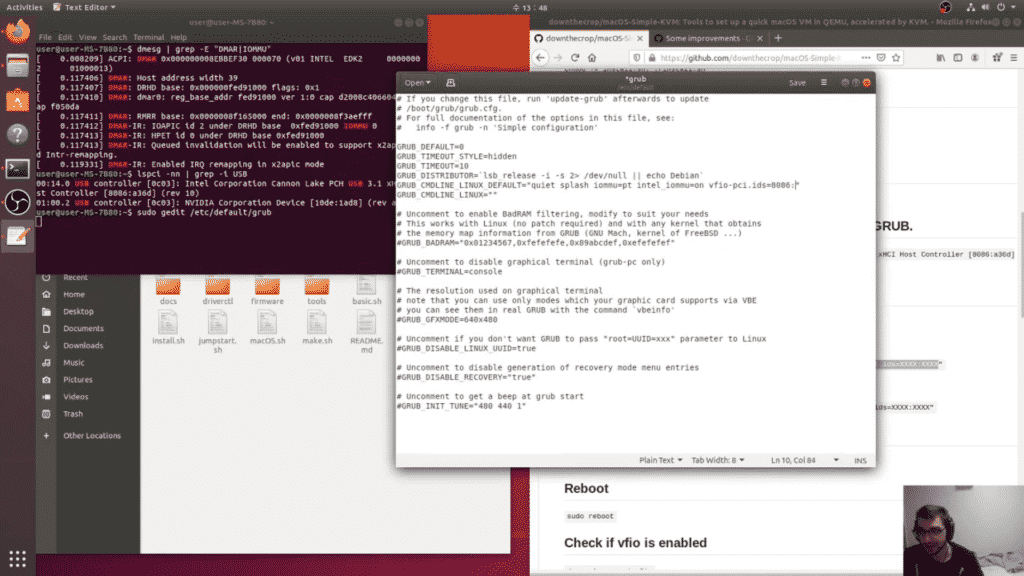
YouTube tutorial on how to enable IOMMU passthrough to QEMU virtual machine on Ubuntu 18.04 host.
checkra1n on Linux using IOMMU PCI USB pass through tutorial on YouTube

Edit February 5 2020 : There is now an official checkra1n release for Linux with no QEMU or Virtualization required! Watch my video here!

Introduction

Hey jailbreakers!

I've got a simple step by step guide on how you can dual boot Windows 10 and Ubuntu Linux 18.04 to run the checkra1n jailbreak tool! Be warned that setup is a little technical and will likely take around an hour. Lets start!

Hardware Compatibility Requirements

First off you're going to need to have a 64-bit processor that has virtualization enabled. You can check this in msinfo32.exe on Windows. Check "System Type" and scroll down to the Hyper-V entries. If System Type is "x64-based PC" the Hyper-V settings are "Yes" you have a CPU with the requirements.

Ubuntu 18.04 Install USB

Download the Ubuntu 18.04 ISO and use the rufus disk imaging tool to write it to any USB flash drive/thumb stick that's 2GB or greater.

Windows 10 Partitioning & Linux Installation Alongside Windows

You also need to partition some free space away from your Windows 10 Installation. Using the Disk Management diskmgmt.msc shrink your C: Volume by 25000MB and leave it as unpartitioned free space. Now boot from USB and run the installation utility in Ubuntu. Select "Install Ubuntu alongside Windows" If this open isn't there please don't continue with the guide as your may accidentally format your drive. Choose a username and password in the setup then click install. Wait for the installation to complete and then reboot into UEFI/BIOS to change the boot priority of your drive to default to Ubuntu. While you're in UEFI/BIOS you must also enable your CPU virtualization technology settings. Save and quit F10 and boot into your Ubuntu install.

Following GitHub Guide

From here you are ready to follow the instructions explained in the GitHub README.md so continue from there. Good luck!

checkra1n on PC/Linux via QEMU macOS Virtualization

Tutorial Guide checkra1n macOS on PC using QEMU and USB Passthrough: https://downthecrop.xyz/blog/tutorial-how-to-run-checkra1n-on-linux-via-qemu-macos-virtualization

EDIT: I have now successfully achieved checkra1n on Ubuntu Linux 18.04 using QEMU and IOMMU Pass through. Installation scripts coming soon!

I have a work around using a live Linux USB. There is no offical release for Windows and Linux currently so macOS must be virtualized using KVM and IOMMU groupings.

Watch my YouTube video explaining my virtualization approach

The checkm8 jailbreak implementation called checkra1n was released Sunday November 10th 2019 but only for macOS. This wasn't done to spite non-apple desktop users. The checkm8 exploit relies of precise control of the desktop USB stack to manipulate DFU mode.

Due to the precision of this communication they needed to craft the checkra1n desktop application to work with the the USB stack. The first USB stack they targeted as macOS, likely due to the developers familiarity with it. You can read more about the exploit in @qwertyoruiop talk at POC2019 which I attended.

So here's the work around. A disk image you can flash to any 16/32GB USB flash drive to boot into which will provide the macOS Virtual Machine and provide USB passthrough.

This is possible and I can get this working. Just give me another few days. You'll just need a 16/32GB USB drive and to boot into a live linux distro, run a script, and then you'll have a macOS Virtual Machine is USB passthrough for use with checkra1n. VirtualBox and VMWare WILL NOT WORK for checkra1n. You need to have lower level access.

About VM's and how this would work:

Stay tuned. I'll have an update soon. You can watch my YouTube video linked above.